iAspirants
Water Crisis in Meghalaya Revealed
Published on:
Share this post
Article Summary
Summary of Water Crisis in Meghalaya
Overview
- Location: Sohra (Cherrapunji) and Mawsynram, known for high annual rainfall (average 11,000 mm).
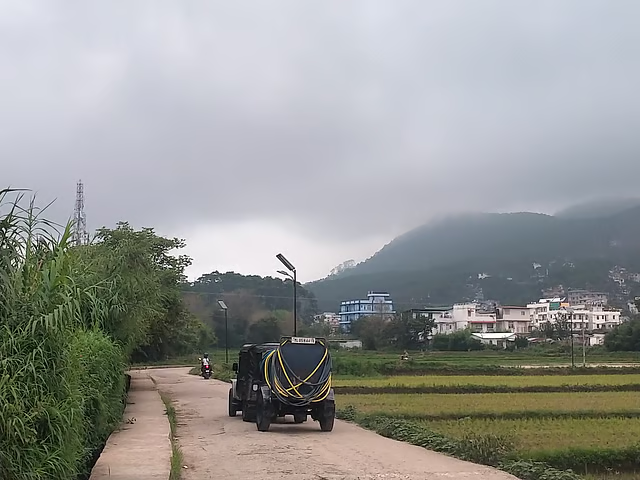
- Issue: Acute drinking water shortage from November to March, with 40% of residents buying water.
Climate and Rainfall Patterns
- Decline in Rainfall: Research from IIT Kharagpur and IITM Pune indicates a decrease of approximately 27.15 mm of rainfall per year over the past four decades in Sohra.
- Climate Change Impact: Notable rainfall deficit (80% in June) attributed to El Niño; linked to rising sea-surface temperatures in surrounding oceans.
- Vegetation Loss: Deforestation and land-use change have reduced the region's capacity to absorb rainfall.
Geographical and Structural Challenges
- Geology: Sohra's high limestone plateau leads to rapid drainage of rainfall, with inadequate retention.
- Water Management: Historical reliance on perennial water availability without infrastructure to capture seasonal rainfall.
Governance and Policy Responses
- Jal Jeevan Mission: Launched in 2019 to provide functional tap connections in rural areas. Current rural tap-water coverage in Meghalaya is 43.57%, lower than the national average of 55.32%.
- Water Infrastructure Issues: Reports indicate many taps either lack connectivity or do not provide water.
- Integration Policy: Drafted Integrated State Water Policy emphasizes sustainable management through community participation.
Socioeconomic Implications
- Water Access Inequality: Access inequity with women and children disproportionately burdened, walking long distances for water.
- Educational Impact: Out of 14,600 schools, only 6,720 have functional drinking water, exacerbating risks during heatwaves.
Environmental and Economic Data
- Economic Loss: The inability to capture and utilize water in a historically water-abundant region raises significant concerns for agriculture and the economy.
- Community Insights: Local governance acknowledges the need for community-centric water management strategies.
Recommendations
- Infrastructure Investment: Focus on water storage systems to retain rainfall, protect catchment areas, and reforest crucial regions.
- Political Commitment: Essential for realizing the proposed water policies and improving governance of water resources.
Implications
The situation in Meghalaya highlights the urgent need for integrated water management systems and governance reforms as climate change poses increasing challenges to water security. The strides made on the ground in policy frameworks could serve as a model for other Indian states facing similar water crises.
Key Terms & Concepts
| Sohra | Location facing water shortage |
| Mawsynram | Currently wettest inhabited place |
| 11,000 mm | Annual rainfall average in region |
| 40% | Residents facing water scarcity |
| 27.15 mm | Annual rainfall decline estimate |
| Indian Institute of Technology, Kharagpur | Conducted rainfall decline study |
| Indian Institute of Tropical Meteorology, Pune | Conducted rainfall decline study |
| El Niño | Influencing rainfall patterns |
| Jal Jeevan Mission | Government scheme for water access |
| 43.57% | Meghalaya tap-water coverage in 2023 |
| 55.32% | National average tap-water coverage |
| Mawphlang dam | Key water reservoir |