iAspirants
Current AffairsPrelims PYQsUPSC CSE SyllabusUPSC CSE StrategyBlogsPricing
Login
iAspirants
Current AffairsPrelims PYQsUPSC CSE SyllabusUPSC CSE StrategyBlogsPricingContact UsLoginSignUp
iAspirants

Your AI-powered companion for UPSC preparation.

Study Resources

  • Current Affairs
  • Prelims PYQs
  • UPSC CSE Syllabus
  • UPSC CSE Strategy
  • Blogs

Practice & Plans

  • Mains Answer Evaluation
  • Pricing
  • Sign Up
  • Login

Company

  • Home
  • About Us
  • Contact Us
  • FAQs

Legal

  • Privacy Policy
  • Terms & Conditions
  • Return Policy

© 2026 iAspirants, Inc. All rights reserved.

  1. Blogs
  2. Polity and Governance

Uniform Civil Code and its History

Published on: 20-Sep-2026

Source: Indian Express

Share this post
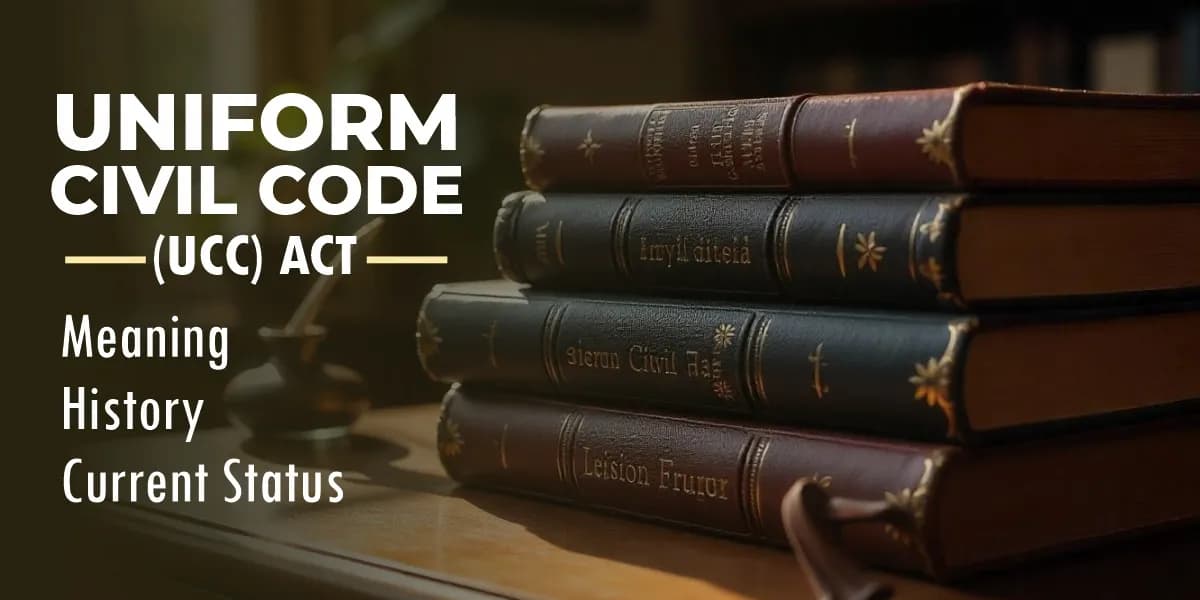
Uniform Civil Code and its History

Article Summary

Key Points on the Uniform Civil Code (UCC)

Background and Historical Context

  • The Uniform Civil Code (UCC) has been a core agenda of the BJP.
  • Union Home Minister Amit Shah announced plans to enact UCC in 21 NDA-ruled states by 2029.
  • Historically, UCC was not consistently included in BJP or BJS election manifestos.
  • RSS's second sarsanghchalak, MS Golwalkar (1972), expressed reservations about mandatory UCC, advocating for diversity in personal laws.

Constitutional Reference

  • The UCC relates to the need for unification of personal laws across religions, potentially reflecting Article 44 of the Directive Principles of State Policy (DPSPs) of the Indian Constitution which calls for a UCC to be provided in the state.

Timeline of UCC Advocacy

  • UCC advocacy gained momentum post-Shah Bano case (1985), marking a shift towards making UCC a priority.
  • The BJP under LK Advani in the mid-1980s made UCC, abrogation of Article 370, and Ram temple issues central to its agenda.
  • The 1989 BJP manifesto proposed a commission to draft UCC. Subsequent manifestos in 1991, 1996, 2004, 2009, 2014, 2019, and 2024 reiterated commitments to UCC.

Challenges in Implementation

  • Scheduled Tribes (over 8.6% of India’s population) have customs that complicate UCC implementation.
  • Disputes center on marriage laws, succession, and definitions of tribal identities, which vary significantly.
  • The implementation of UCC has seen exclusions, as evidenced by Uttarakhand's decision to not include Scheduled Tribes in recent laws.

Current Government Position

  • Amit Shah's commitment to UCC aims to fulfill long-standing promises, particularly post-Ram temple and Article 370 abrogation.
  • The ruling BJP may seek to establish a coherent legislative approach to the UCC to leave its prior commitments realized.

Comparative Overview

  • Historical opposition to UCC has evolved, indicating shifts in both societal attitudes and political strategies concerning personal laws.
  • The opposition and support have often reflected broader societal and political challenges, impacting consensus around the formulation of a UCC.

Societal Implications

  • Introduction of UCC could impact diverse communities and the nature of personal laws across religions.
  • The focus on “unity in diversity” remains a contentious point reflecting India's complex socio-cultural fabric.

Conclusion

The UCC remains a significant and contentious issue in Indian politics, reflecting historical shifts in ideology, constitutional principles, and socio-legal frameworks. The unfolding discussions and policy proposals indicate a complex negotiation between India's diverse communities and the central government's legislative objectives.

Key Terms & Concepts

Uniform Civil CodeCore agenda of BJP
Amit ShahPromised enactment by 2029
Bharatiya Jana SanghPredecessor of BJP
RSSIdeological parent of BJP
Article 370Abrogation demand by BJP
Shah Bano caseTurning point for UCC
Law CommissionProposed study for UCC
Uttarakhand UCCExcludes Scheduled Tribes
Scheduled TribesOver 8.6% of population
People of India seriesDocumentation of communities
NDA-ruled statesFocus for UCC implementation
1955 Hindu Code BillCodified traditional laws
1987

Mind Map for UPSC Civil Services Revision

Turn UPSC Civil Services Current Affairs Into Exam-Ready Notes

Reading Polity and Governance current affairs is half the work. Revise them with ready-made notes and test what actually stuck.

  • Daily UPSC Civil Services current affairs analysis
  • Revision notes, mind maps & MCQs
  • Prelims mock tests with instant results

Related UPSC Civil Services Current Affairs Articles

Bureaucrats Asset Declaration Review 2026
Polity and Governance05-Nov-2026

Bureaucrats Asset Declaration Review 2026

Summary of Bureaucrat Asset Declarations in India

Constitutional References:

  • Section 44 of the Lokpal Act: Mandates public disclosure of movable and immovable assets by public officials, akin to electoral candidates and MPs. This was amended in December 2016 to establish specific rules for asset declaration by public servants.
Advani replaced Vajpayee
1991Law Commission study proposed
2014Manifesto for UCC
2019Line for UCC drafting
2024Continued UCC commitment
Narendra ModiFace of BJP campaigns
Practise Mains answer writingUpload a handwritten answer and get it evaluated

Key Facts and Figures:

  • Number of Officials Reviewed: 102 out of 131 Secretary-level officials' asset declarations were analyzed for 2026.
  • Total Self-Acquired Properties Declared: 244 properties, including:
    • 219 residential,
    • 3 commercial,
    • 22 agricultural parcels.
  • Disclosure Gaps:
    • 115 properties lacked information on area/dimensions.
    • 115 properties did not have current valuation listed.
    • Only 129 properties had a "present value" reported.
  • Property Ownership Statistics:
    • 44 officials and/or their spouses own three or more properties.
    • Seven officials own five properties each; 13 own four each; 24 own three each.

Notable Individuals and Properties:

  • The leading official declared eight self-acquired properties, predominantly located in Kerala.
  • A close second declared six properties across multiple states, including Maharashtra and Delhi.

Governance and Oversight Mechanism:

  • Bureaucrats must report their assets annually by January 31, with disclosures made public by March 31 since 2011.
  • This practice was initiated in response to demands from the anti-corruption movement and the Right to Information (RTI) petitions.

Administrative Context:

  • Officials included: 95 Secretaries from Central Government departments (e.g., President’s Secretariat, Prime Minister’s Office, NITI Aayog) and Chief Secretaries from states and Union Territories.
  • The categories of officials also cover various services, including IAS, IPS, and Indian Foreign Service members.

Implications of Findings:

  • Majority of properties are situated in Delhi-NCR and state capitals, often in cooperative housing projects for government employees.
  • Public comments and questions were raised regarding the lack of a verification mechanism for asset declarations and the absence of rules for asset reporting established by the Lokpal Act.

Remarks on Accountability:

  • The declarations indicate substantial wealth among officials, with a notable percentage failing to provide complete asset details. The public continues to expect transparency and accountability from their elected and appointed officials, especially in light of ongoing discussions regarding corruption and governance standards.

This summary encapsulates the critical data and elements relating to bureaucratic asset declarations in India, emphasizing the importance of transparency and accountability within public service.

Ladakh Administration Issues School Order
Polity and Governance04-Nov-2026

Ladakh Administration Issues School Order

Key Facts & Developments:

  1. Legal Status of Desert Flower School:

    • The Ladakh administration has instructed the Himalayan Institute of Alternatives Ladakh (HIAL), specifically concerning the Desert Flower School, to cease operations due to lack of necessary clearances.
    • The land allotment to HIAL was canceled in August 2025, and activities commenced without approvals from relevant authorities.
  2. Ongoing Judicial Proceedings:

    • The case regarding HIAL is currently sub judice in the High Court of Jammu & Kashmir and Ladakh, implying legal proceedings are ongoing.
  3. Appeal to the President:

    • Sonam Wangchuk has reached out to President Droupadi Murmu, urging intervention to protect indigenous rights and ecological balance in Arunachal Pradesh amid community resistance against the Siang Upper Multipurpose Project.
  4. Constitutional References:

    • Wangchuk emphasizes the need for constitutional safeguards, specifically under the Sixth Schedule of the Indian Constitution, which provides for the administration of tribal areas in northeastern states.
  5. Environmental & Community Concerns:

    • Wangchuk alerted about a heavy security presence and violence against local activists and villagers opposing the project in Arunachal Pradesh, highlighting the need for protecting democratic rights and local ecological systems.
  6. Allegations of Intimidation:

    • Reports suggest instances of police excesses and intimidation of villagers resisting development projects. Wangchuk draws parallels between situations faced by Ladakh and Arunachal Pradesh regarding suppression of legitimate local concerns.
  7. Strategic Importance of Indigenous Relations:

    • Emphasis on fostering trust between indigenous communities and national security, noting that treating local voices with respect is essential for long-term development security.
  8. Government Schemes and Policies:

    • Wangchuk's appeals underscore the potential for collaborative development that respects local ecological and cultural considerations, in contrast to exploitative models.

Economic & Social Dynamics:

  • The ongoing resistance reflects broader social dynamics where local communities seek participatory governance and acknowledgment of their socio-economic rights through protective constitutional and legal frameworks.

Conclusion: The developments in Ladakh and Arunachal Pradesh resonate with broader themes of environmental protection, indigenous rights, and the legal responsibilities of governmental authorities in India. Wangchuk’s engagements highlight critical intersectional issues of ecology, democracy, and community empowerment within the context of national advancement and safety.

New Mandatory Internship Program for Students
Polity and Governance04-Nov-2026

New Mandatory Internship Program for Students

Summary of Key Points from APSCHE Internship Initiative

Overview of the Initiative:

  • Mandatory Internship: Introduction of a semester-long internship requirement for all undergraduate students in Andhra Pradesh starting November 16, 2026.
  • Duration and Credits:
    • 360 hours of internship equivalent to 12 academic credits.

Objectives:

  • Industry-Academia Linkage: Aimed at strengthening ties between educational institutions and industries.
  • Enhance Employability: Designed to improve job readiness of graduates.

Compliance and Guidelines:

  • National Education Policy (NEP) 2020: The program aligns with NEP 2020 articulating the need for practical experience in education.
  • UGC Guidelines and CCFUP: Developed in accordance with the University Grants Commission (UGC) and the Curriculum and Credit Framework for Undergraduate Programmes.
Protests and Legal Rights in India
Polity and Governance01-Nov-2026

Protests and Legal Rights in India

Exam-Focused Notes on Peaceful Protests and Constitutional Rights in India

1. Constitutional Rights Related to Protests:

  • Article 19(1)(b): Provides the right to assemble peacefully.
  • Article 19(1)(d): Ensures the right to move freely throughout the territory of India.
  • Article 21: Enshrines the right to life and personal liberty, which has been extended to include the right to peaceful protest.

2. Judicial Rulings:

  • Mazdoor Kisan Shakti Sangathan v. Union of India (2018):
    • Supreme Court recognized the necessity of designated protest sites to balance the right to protest with public order.
    • The court ruled that Jantar Mantar should be a designated site for protests, subject to obtaining necessary permissions, acknowledging its role in democratic expression.
  • Amit Sahni v. Commissioner of Police (2020):
    • Affirmed that while the right to protest is fundamental, it cannot disrupt daily life significantly.

3. Designated Protest Sites:

  • New protest site: Ramlila Maidan, situated 6 km from Parliament.
  • Other sites:
    • CBD ground in Shahdara: 14 km from Parliament.
    • Burari ground: 23 km from Parliament.
  • Denotification of Jantar Mantar as a protest site criticized and contested; currently, booking fees for Ramlila Maidan range from Rs 50,000 to Rs 1 lakh per day.

4. Issues with Current Protest Regulations:

  • There is no constitutional requirement for designated protest sites. They serve as an administrative mechanism to manage protests.
  • High booking fees could inhibit access to the right to protest for marginalized groups.
  • The availability of a designated site is critical; restrictions that render protest unfeasible violate the spirit of the right to assemble.

5. Economic Considerations:

  • Significant costs for using protest sites raise concerns about the inclusivity of the right to protest.
  • Protest accessibility is pivotal, especially for economically disadvantaged groups who may be unable to afford high venue costs.

6. Government and Administrative Responsibilities:

  • Governments must ensure designated protest sites are available for their intended use, rather than for general events.
  • Citizens have the right to assemble peacefully in non-designated areas unless prohibitory orders are in place.

7. Conclusion:

  • The right to protest is a cornerstone of democracy in India, necessitating a balance between freedom of expression and public order.
  • Ongoing discussions on protest site regulations and their implications highlight the challenges in preserving democratic rights while managing civic disturbances.
  • National Credit Framework (NCrF): Integration with NCrF emphasizes a standards-based approach to education and employability.
  • Implementation Details:

    • Institutional Structure: Final-year students will undertake internships based on their degree duration:

      • Three-year degree courses: Sixth semester.
      • Four-year degree courses (including Honours): Eighth semester.
    • Institute-Industry Connect (IIC) Portal:

      • A platform for students to find stipulated internships.
      • Required registration of all undergraduate students via the portal, integrated with DigiLocker for Automated Permanent Academic Account Registry (APAAR) IDs.

    Internship Prioritization:

    • Stipend-based Opportunities: Priority will be given to internships that offer stipends.
    • Non-stipendiary internships: Allowed only if stipend opportunities are inadequate.

    Registration for Industry Partners:

    • Commencement: Industry partners can register starting November 4, 2026.
    • Eligibility: Companies (including MSMEs, NGOs, government departments) must verify details (e.g., incorporation certificates, PAN, GST registration) for eligibility to post internships.

    Areas of Focus for Internships:

    • Special emphasis on sectors including:
      • Artificial Intelligence
      • Quantum Technology
      • Semiconductors
      • Solar Energy
      • Green Hydrogen
      • Ports and Emerging Technologies

    Responsibilities of Educational Institutions:

    • Universities and colleges directed to:
      • Appoint nodal officers and internship coordinators to facilitate student registration and oversee the process.
      • Ensure compliance with guidelines and immediate circulation of information regarding the internship requirements.

    This summary encapsulates the foundational aspects and critical implications of the APSCHE's internship initiative, reflecting its alignment with national educational frameworks and economic objectives.