iAspirants
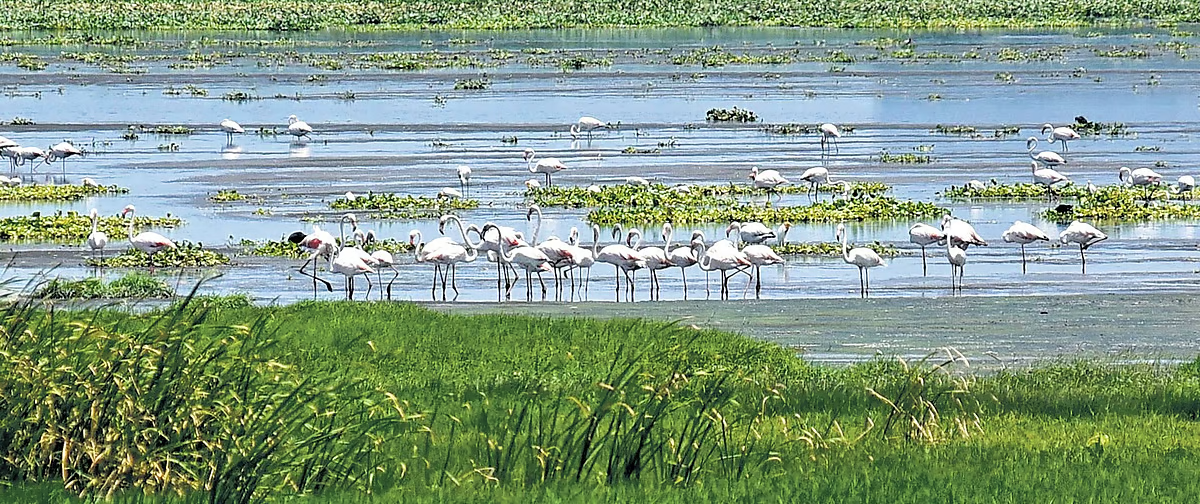
Policy Gaps in Pallikaranai Marshland
Published on:
Share this post
Article Summary
Summary of the Pallikaranai Collective Report
Key Recommendations
Formation of Committee:
- An independent interdepartmental committee is proposed to study policy and legislative gaps regarding the Pallikaranai marshland.
- This committee should include subject-matter experts and representatives of the community to create a coordinated implementation plan.
Policy Review and Legislative Gaps:
- The report titled ‘Citizen’s Charter for Pallikaranai Watershed’ highlights significant gaps in existing policies:
- Tamil Nadu Water Policy (1994) has not been updated.
- A State Water Policy drafted in 2024 remains unnotified.
- No Flood Plain Zoning Act has been enacted in Tamil Nadu despite a central government template issued in 1975.
- The report titled ‘Citizen’s Charter for Pallikaranai Watershed’ highlights significant gaps in existing policies:
Data Transparency:
- The Thiruppugazh Committee's final report from May 2023, which studied 1,189 square kilometers and 30 years of flood data, is not publicly accessible.
- The Tamil Nadu Water Resources Information and Management System contains data on 92,068 tanks and 127 reservoirs, which is not available to the public.
Environmental Management Proposals
Wetland Management:
- The charter emphasizes that Wetland Rules are poorly implemented and that Pallikaranai marshland has not been formally notified as protected under these rules.
- Demands include:
- Demarcation and mapping of wetlands and floodplains under the Wetland (Conservation and Management) Rules, 2017.
- Implementation of the Flood Plain Zoning Act.
- Regular desilting and maintenance of canals.
- Prevention of sewage discharge into water bodies.
Waste Management:
- Advocates for the source segregation of household waste.
Protective Measures:
- Calls to remove encroachments and illegal infrastructure within the Pallikaranai Ramsar site and its buffer zones.
Legal and Constitutional Context
- The recommendations align with environmental conservation principles outlined in the Indian Constitution, particularly Article 48A, which directs the State to protect and improve the environment and safeguarding of forests and wildlife.
Significance
- The proposed measures aim to enhance the ecological health of Pallikaranai marshland, a vital wetland ecosystem, and facilitate better water management and flood control for the area.
Conclusion
The Pallikaranai Collective's report calls for immediate and coherent action to address significant environmental concerns regarding the Pallikaranai marshland, underlining the need for effective policy implementation and data transparency for sustainable water management.
Key Terms & Concepts
| Pallikaranai marshland | Geographical Area Under Study |
| Tamil Nadu Water Policy | Policy for Water Management |
| Flood Plain Zoning Act | Legislative Requirement for Flood Control |
| Wetland (Conservation and Management) Rules, 2017 | Regulation for Wetland Protection |
| Thiruppugazh Committee | Study on Flood Data |
| Chennai Wetlands Action Collective | Conservation Group Involved |
| Oorvani Foundation | NGO Collaborating on Charter |
| Pallikaranai Ramsar site | Protected Wetland Area |
| 92,068 tanks and 127 reservoirs | Water Bodies Data In Tamil Nadu |
| 1,189 square kilometres | Area Studied for Flood Impact |
| May 2023 | Report Submission Date |
| 1994 | Year of Water Policy Drafting |