iAspirants
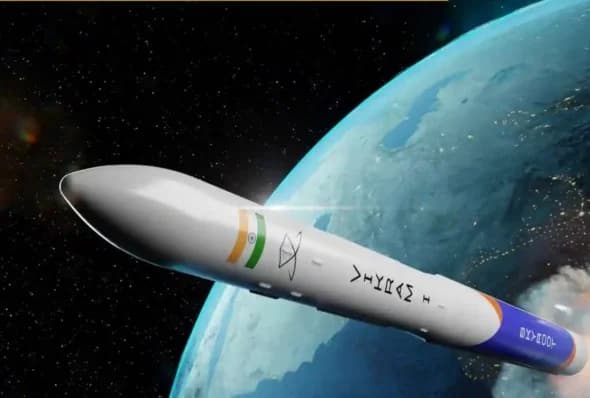
India's Vikram-1 Achieves Historic Launch
Published on:
Share this post
Article Summary
Exam-Focused Summary Notes on Vikram-1 Launch
1. Launch Overview:
- Vikram-1, India’s first privately-built rocket, successfully launched by Skyroot Aerospace on July 18, 2026, from Sriharikota.
- Achieved orbit and deployed multiple technology demonstration satellites.
- Launch mission named "Aagaman," symbolizing the arrival of a new era in India's space sector.
2. Significance:
- India becomes the third country globally (after USA and China) with capabilities for private sector space launches.
- Marks the beginning of commercial spaceflight in India.
- Prime Minister Narendra Modi described it as a defining moment, promoting youth-led innovation.
3. Technical Specifications:
- Vikram-1 is a four-stage rocket, seven stories tall.
- Utilizes high-thrust solid fuel motors and a liquid propellant-based engine.
- Designed to carry small satellites up to 350 kg to low-earth orbits (450 km altitude).
- 3D printed engines contribute to reduced production time and costs.
4. Important Dates & Events:
- Previous successful sub-orbital flights in 2022 (Vikram-S) and 2024 (Agnikul’s Agniban).
- An initial countdown halt occurred five minutes before launch; launch rescheduled and executed at 12:05 PM IST.
5. Government and Institutional Support:
- The Indian Space Research Organisation (ISRO) actively supported the private space sector.
- The government’s decision to open space sector to private players seen as pivotal by Modi.
6. Key Individuals:
- Co-founders of Skyroot Aerospace: Pawan Kumar Chandana and Naga Bharath Daka.
- Notable attendees during launch: ISRO Chairman V. Narayanan, former ISRO chairpersons, Science and Technology Minister Jitendra Singh among others.
7. Awards and Honors:
- The rocket is named after Vikram Sarabhai, the architect of India's space program.
- Individual engines named "Kalam" (for Dr. APJ Abdul Kalam) and "Raman" (for Dr. C. V. Raman).
8. Industry Advancements:
- Reflects India’s growing private space ecosystem, building critical global infrastructure for space sustainability.
- Adoption of innovative manufacturing processes through 3D printing in rocket design.
9. Future Implications:
- Encourages aspiring engineers and entrepreneurs in India’s burgeoning space industry.
- Development marks significant progression in capabilities, positioning India competitively in the global space sector.
10. Conclusion:
- The successful launch of Vikram-1 underlines the culmination of governmental policies fostering private participation in space exploration and innovation, marking a transformative phase in India's scientific and technological landscape.
These notes provide an outline of important facts, initiatives, and developments associated with the launch of the Vikram-1 rocket, relevant for exams focused on science and technology, government policies, and India's evolving space landscape.
Key Terms & Concepts
| Vikram-1 | India's first private launch vehicle |
| Skyroot Aerospace | Manufacturer of Vikram-1 rocket |
| ISRO | Supports India's space program |
| Aagaman | Launch mission name |
| 450 km | Altitude of deployed satellites |
| 350 kg | Payload capacity to low-Earth orbits |
| 3-D printed engines | Innovative rocket engine technology |
| Sriharikota | Launch facility location |
| July 18, 2026 | Date of launch |
| Kalam and Raman | Names of rocket engines |
| India’s space sector | Industry context for launch |
| Dr. Vikram Sarabhai | Father of India's space program |
| Dr. APJ Abdul Kalam |