iAspirants
Current AffairsPrelims PYQsUPSC CSE SyllabusUPSC CSE StrategyBlogsPricing
Login
iAspirants

Your AI-powered companion for UPSC preparation.

Quick Links

  • Home
  • About Us
  • Current Affairs
  • Prelims PYQs
  • UPSC CSE Syllabus
  • UPSC CSE Strategy
  • Blogs

Company

  • Pricing
  • FAQs
  • Contact Us
  • Login

Legal

  • Privacy Policy
  • Terms & Conditions
  • Return Policy

© 2026 iAspirants, Inc. All rights reserved.

  1. Blogs
  2. Environment and Ecology

India's Monsoon Forecast and Challenges

Published on: 26-Oct-2026

Source: The Hindu

Share this post

India's Monsoon Forecast and Challenges

Article Summary

Monsoon and Climate Analysis in India

Current Climate Conditions

  • Monsoon Deficit: The southwest monsoon (June-September) recorded 759.4 mm of rainfall, a 12.6% deficit from the normal 868.6 mm, marking the driest year in 11 years.
  • Kharif Sowing Impact: The rainfall deficiency has adversely affected kharif crop sowing, contributing to food inflation.

Northeast Monsoon Expectations

  • Timing: The northeast monsoon spans October to December.
  • Forecast: India Meteorological Department (IMD) predicts 'normal' rainfall according to a 50-year average with a 12% error margin.
  • Regional Variations: Most areas may experience below-normal rainfall, except parts of northwest and southern India, expected to get normal to above-normal precipitation.

Climate-Related Events and Historical Context

  • El Niño Influence: The current conditions are influenced by a significant El Niño, which has been linked to changing rainfall patterns, notably:
    • 2015: Chennai faced severe flooding, with over 500 fatalities and 1.8 million displaced.
    • Historical Variance: El Niño years have shown unpredictable rainfall, with some years (e.g., 1997, 2009) yielding above-normal northeast monsoon rainfall, while others (e.g., 1982, 2002) resulted in poor rainfall.

Government Preparedness Recommendations

  • Disaster Management: Both the Central Government and southern states are advised to enhance disaster preparedness by:
    • Clearing stormwater drains.
    • Fortifying shelters.
    • Enhancing infrastructure provisions against potential damage.
    • Improving weather-warning systems to mitigate risks associated with torrential rains.

Statistical Background

  • Rainfall Data: A significant deviation from normal rainfall patterns poses a risk to agricultural output and food security.
  • Rainfall Patterns: Understanding the interaction between El Niño and monsoon behavior remains an area of active research.

Conclusion

The IMD's forecast combined with historical data emphasizes the need for proactive governance in disaster management, especially in the context of unpredictable rainfall due to climate phenomena like El Niño. Effective measures must be in place to minimize the impact on agriculture and ensure food security amidst changing climatic norms.

Key Terms & Concepts

Northeast MonsoonSeasonal rainfall contributor
El NiñoInfluences monsoon rainfall patterns
759.4 mmJune-September rainfall total
868.6 mmNormal June-September rainfall
12.6%Rainfall deficit percentage
2015Year with flooding in Chennai
500 livesCasualties in 2015 floods
18 lakhPeople displaced in 2015 floods
October to DecemberNortheast monsoon period
50-year averageNormal rainfall reference
Weather warning forecastsPrecautions for severe weather

Mind Map for UPSC Civil Services Revision

Turn UPSC Civil Services Current Affairs Into Exam-Ready Notes

Reading Environment and Ecology current affairs is half the work. Revise them with ready-made notes and test what actually stuck.

  • Daily UPSC Civil Services current affairs analysis
  • Revision notes, mind maps & MCQs
  • Prelims mock tests with instant results

Related UPSC Civil Services Current Affairs Articles

Bengaluru's Tunnel and Environmental Concerns
Environment and Ecology25-Oct-2026

Bengaluru's Tunnel and Environmental Concerns

Summary of Key Points

Urban Development and Environmental Impact

  • Bengaluru is planning a 2.2 km tunnel aimed at alleviating traffic congestion, which will necessitate the felling of approximately 1,128 trees.
  • Local residents are protesting against this decision, symbolically hugging trees to express their discontent.

Environmental Concerns and Biodiversity

  • The text references the degradation of the Aravalli range, highlighting ecological challenges over the last two decades.
  • Illustrates the coexistence of urban development with nature through experiences in Colombo, a Ramsar wetland city, showcasing its diverse ecosystem within an urban setting.

Lessons from Nature

  • Adaptability and Rights in Nature:
    • Different species (crocodiles, terrapins, porcupines, monkeys, peacocks, fishing cats) exhibit behaviors that reflect broader themes of ownership, survival, and adaptability.
    • The author reflects on the philosophical lessons derived from these interactions, touching on concepts of property, identity, and protection mechanisms.

Key Concerns in Urban Planning

  • Urban planning should prioritize ecological balance, as exemplified by the idea that constructing a tunnel that destroys trees does not address the root issues of urban traffic.
  • The narrative critiques the approach to city planning that neglects the biodiversity and ecological context, suggesting that a "human-centric" viewpoint risks erasing important natural narratives.

Urban Biodiversity Importance

  • Advocates for an urban design that considers the interconnectedness of life, proposing that a focus on maintaining ecological integrity is essential for sustainable development.
  • Emphasizes the importance of urban nature as a significant contributor to the quality of life and city resilience.

Conclusion

  • The writer urges a reevaluation of urban development strategies to incorporate environmental conservation, ensuring that urban centers like Bengaluru do not lose their rich biodiversity, analogous to the historical loss of wildlife in Udaipur. The concept of "designing cities that acknowledge the intricate web of life" serves as a call to action for urban planners and policymakers.
Cyclone Preparedness in Southern Odisha
National and International Importance25-Oct-2026

Cyclone Preparedness in Southern Odisha

Summary Notes on Cyclonic Preparations in Odisha and Andhra Pradesh

Cyclone Preparedness and Response:

  • Affected Areas: Schools, colleges, and Anganwadi centres in five districts of Odisha (Ganjam, Gajapati, Rayagada, Koraput, and Malkangiri) will remain closed on October 28-29 due to cyclone threats.
  • Cyclonic Development:
    • IMD forecast indicates a low-pressure area in the Bay of Bengal is expected to intensify into a depression and subsequently into a cyclonic storm.
    • Landfall is predicted near the Andhra Pradesh coast by October 31, with wind speeds between 80-90 km/hr and heavy rainfall expected.

Government Response:

  • State Alert Level: Odisha government on high alert; Chief Minister Mohan Charan Majhi emphasized zero casualties and directed officials to leverage lessons from previous cyclones.
  • Preparation Measures:
    • Collectors authorized to enforce closures based on evolving cyclone status.
    • Identification of vulnerable areas for emergencies and provision of cyclone shelters.
    • 60 Odisha Disaster Rapid Action Force (ODRAF) teams and 225 fire service teams on standby, while 17 National Disaster Response Force (NDRF) teams are ready for deployment.
    • Advisory for fishermen against sea ventures and hospitals to stock anti-snake venom and medical supplies.

Impact on Agricultural Sector:

  • Major harvesting season approaching; farmers are being alerted to safely harvest and store crops due to cyclone risk.

Neighboring States:

  • Authorities in Andhra Pradesh also monitoring the situation but no closures or evacuations ordered as of now.
  • Strong, gusty winds and rainfall expected starting Monday.

Meteorological Information:

  • IMD reports suggest widespread rainfall commencing from Monday, peaking on Tuesday and Wednesday.

Key Considerations:

  • Safety Measures: Importance of prioritizing moving vulnerable populations (e.g., patients, pregnant women) to health centers and assuring readiness of emergency shelters.
  • Infrastructure Preparedness: Engineering departments tasked with readiness to clear routes blocked by fallen trees for swift recovery post-cyclone.

Conclusion: The situation showcases proactive measures by both Odisha and Andhra Pradesh in disaster management, especially in safeguarding lives and property amidst impending cyclonic conditions.

Cyclonic Storm Set to Intensify
Environment and Ecology25-Oct-2026

Cyclonic Storm Set to Intensify

Summary of Cyclonic Storm in Bay of Bengal

Weather Forecast and Cyclone Development

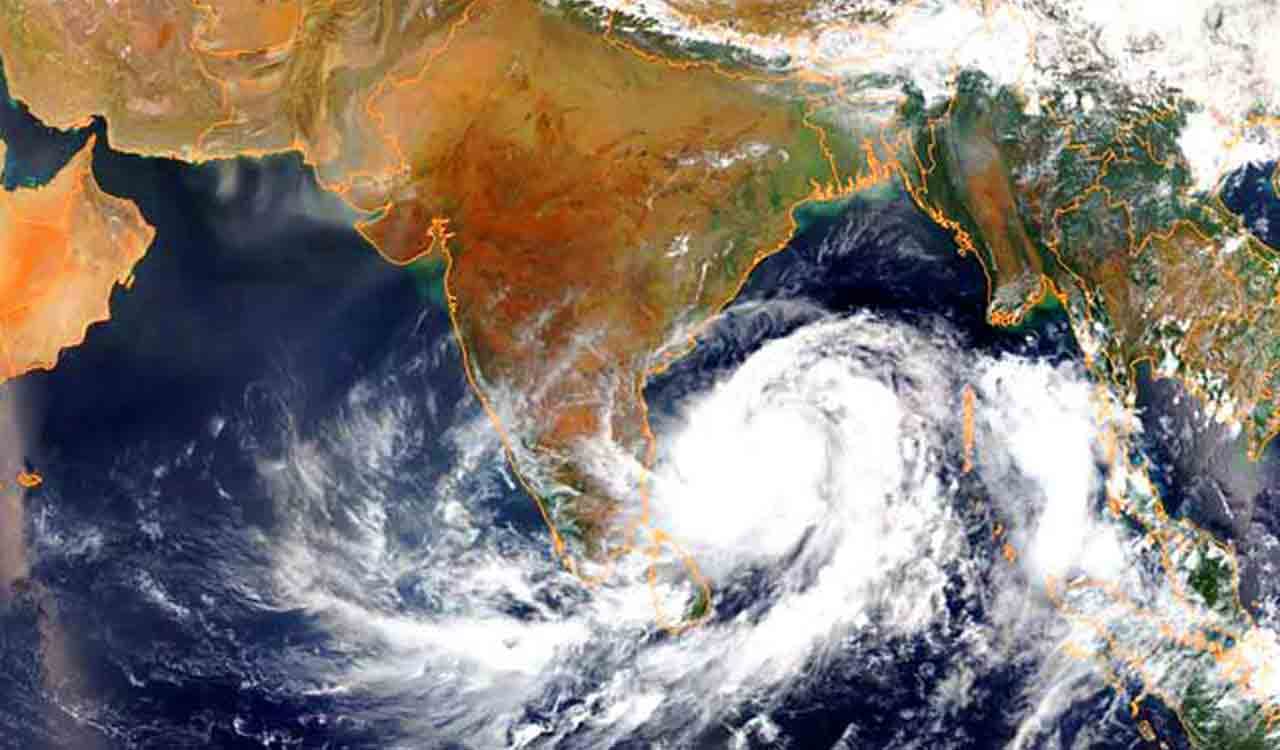
  • The India Meteorological Department (IMD) has indicated a potential cyclonic storm developing over the Bay of Bengal.
  • Expected Intensity:
    • Likely classification: Very Severe Cyclonic Storm.
    • Maximum sustained wind speed: 118 km/h to 221 km/h. Current forecasts predict wind speeds may reach 130 km/h, compared to 65 km/h during last year’s Montha.

Cyclone Tracking and Path

  • A low-pressure area formed on the east-central Bay of Bengal is anticipated to evolve into a deep depression, then a cyclonic storm.
  • Current position: Approximately 510 km off Andaman Islands, 820 km off Vishakhapatnam, 910 km off Kakinada, 1,020 km off Machilipatnam, and 1,100 km off Bapatla.
  • Expected to intensify and change course towards the Andhra Pradesh coast near Bapatla and Visakhapatnam by October 28.

Anticipated Impact on Andhra Pradesh

  • Expected event: Cross the Andhra Pradesh and Yanam coasts with sustained winds of 115 km/h to 125 km/h, gusting to 140 km/h.
  • IMD has issued a Red Alert for 13 districts:
    • October 27: Krishna and Bapatla.
    • October 28: Visakhapatnam, Alluri Sitharama Raju, Anakapalli, Kakinada, Dr. B.R. Ambedkar Konaseema, East Godavari, West Godavari, Eluru, NTR, Krishna, Guntur, and Bapatla.

Rainfall Predictions

  • Isolated extremely heavy rainfall is predicted in the aforementioned districts, with cyclone-induced rainfall activity expected to spike from October 27.
  • Light showers may precede this on October 25 and 26.
  • Recent rainfall data:
    • Simhadripuram (YSR Kadapa): 81.5 mm of rainfall.
    • Malapuram (Anantapur): 74.5 mm.

Government Preparations and Response

  • Andhra Pradesh Chief Minister N. Chandrababu Naidu has instructed officials to prepare for the cyclone's impact, emphasizing caution and proactive measures.
  • A thorough flood management and water conservation plan is called for in anticipation of severe weather conditions.

Conclusion

This situation highlights the necessity for disaster preparedness and response mechanisms in vulnerable regions, driven by climate patterns leading to increased cyclonic activity. The synergistic roles of government agencies, meteorological forecasting, and community readiness are critical in mitigating potential impacts of severe weather events.

Cyclone Formation in Bay of Bengal
Environment and Ecology24-Oct-2026

Cyclone Formation in Bay of Bengal

Weather Advisory and Cyclonic Storm Forecast

Cyclonic Development:

  • A low-pressure area over the east-central and adjoining southeast Bay of Bengal is forecast to intensify:
    • Expected to become a depression on Saturday.
    • Projected to develop into a deep depression on Sunday and a cyclonic storm by Monday morning.
    • Predicted to impact north Andhra Pradesh and south Odisha coasts.

Meteorological Insights:

  • K. Naga Ratna, Head of the Amaravati Meteorological Centre, indicates this will likely be a severe cyclonic storm, with winds reaching speeds up to 145 kmph.
  • Some forecasts suggest it could escalate to a very severe cyclonic storm, with wind speeds ranging from 120 to 165 kmph, gusting to 185 kmph.
  • Anticipated storm surge: 1 to 2 meters.

Red and Orange Weather Warnings:

  • Red warnings for extremely heavy rain have been issued for Visakhapatnam and Anakapalli districts on October 27.
  • Extended red warnings for October 28 include districts such as Alluri Sitharama Raju, Kakinada, East Godavari, Konaseema, and West Godavari.
  • Orange alerts for heavy to very heavy rainfall on October 28 cover Visakhapatnam, Srikakulam, Parvathipuram-Manyam, Vizianagaram, Eluru, and Krishna districts.
  • A yellow watch for heavy rain in specific districts on October 29.

Recent Rainfall Data:

  • In the 24 hours ending October 27, Amalapuram (Konaseema district) received 94 mm of rain; Nellore received 73 mm.
  • Vijayawada and Guntur reported substantial rainfall.

Public Safety Recommendations:

  • Fishermen are advised against venturing into the sea and should return to port due to anticipated rough weather.
  • The Andhra Pradesh State Disaster Management Authority (APSDMA) emphasizes the need for public vigilance and safety measures for those living in affected areas.
  • Emergency helplines available: 112, 1070, and 18004250101.

Temperature Observations:

  • Tuni recorded the highest temperature at 36°C.
  • Nellore reported the lowest temperature at 27.3°C.

Additional Forecasts:

  • Light to moderate rain predicted in coastal Andhra Pradesh and a few locations in Rayalaseema on Saturday.
  • The APSDMA lists certain districts for rain warnings following the cyclonic storm forecasts.

As the situation develops, continued monitoring by the India Meteorological Department (IMD) will guide further advisories and safety recommendations.