iAspirants
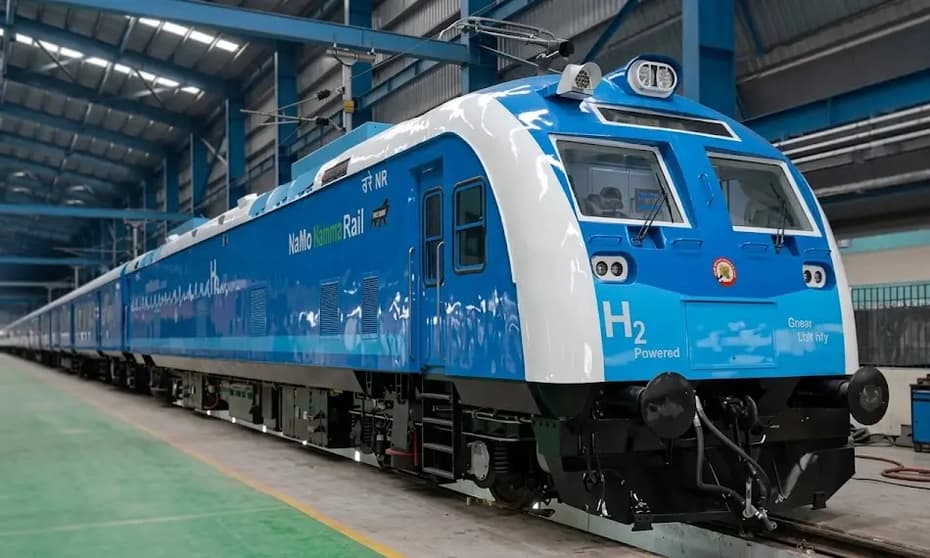
India's First Hydrogen Fuel Cell Train
Published on:
Share this post
Article Summary
Exam-Focused Notes on India's First Hydrogen Fuel Cell Train
Overview
- India's First Hydrogen Fuel Cell Train: Set to revolutionize sustainable rail transport with a capacity of approximately 2,600 passengers.
- Environmental Impact: Utilizes hydrogen, a clean fuel, generating nearly zero emissions during operation.
Safety Features
- Multi-layered Safety Systems: Trains equipped with mechanisms to detect hydrogen leaks, heat, flames, and smoke.
- Operational Speed: Designed for a maximum speed of 110 km/h with operational speed on the Jind-Sonipat section at 75 km/h.
Technological Innovation
- Hydrogen and Oxygen Reaction: The train generates electricity through a chemical reaction within the train, producing only water vapor as a byproduct.
- Proton Exchange Membrane (PEM) Fuel Cell: Functions as a small power plant, converting stored hydrogen and atmospheric oxygen into electricity.
Infrastructure Developments
- Hydrogen Refueling Facility: Established in Jind, Haryana, it includes:
- Hydrogen Production: Generated via electrolysis of water.
- Storage and Distribution: Can store up to 3,000 kg of hydrogen; includes compression and dispensing systems.
Government Initiatives
- Indian Railways: Leading the development of this train, showcasing advancements in domestic engineering and technology.
- National Green Hydrogen Mission: Aligns with India's long-term goals for net-zero emissions and sustainable mobility.
Economic Considerations
- Reduction in Diesel Dependency: Significant decrease in reliance on imported diesel due to extensive electrification over the past 12 years, with over 99% of broad gauge routes electrified.
International Context
- Global Landscape: Hydrogen trains are in early stages globally, with Germany being the first to commercialize hydrogen passenger trains. Other countries like France, Italy, and Japan are exploring similar projects.
Future Prospects
- Expansion Plans: Indian Railways is exploring hydrogen technology deployment on heritage routes like the Kalka-Shimla line.
- Pilot Project to National Program: The Jind-Sonipat project is seen as a precursor to a structured national program for hydrogen-powered rolling stock.
Scientific and Technical Details
- Fuel Cell Technology: Each driving power car produces 1,200 kW (1600 HP) of power to propel the train.
- Safety Mechanisms: Continuous monitoring for hydrogen leaks and automatic shut-off systems to enhance passenger safety.
- International Compliance: The entire hydrogen system adheres to international standards (NFPA-2, ISO 19880 series) and has been certified by TÜV SÜD.
Conclusion
- Significance: The hydrogen fuel cell train represents a major step towards sustainable transport in India, contributing to environmental goals and energy independence while enhancing passenger capacity and safety in rail travel.
Key Terms & Concepts
| Hydrogen Fuel Cell Train | First in India |
| 2600 passengers | Train capacity |
| Zero emissions | Environmental benefit |
| 75 km/h | Operational speed |
| 110 km/h | Design speed |
| Proton Exchange Membrane | Power generation method |
| Green Hydrogen Plant | Hydrogen production facility |
| 3,000 kg | Hydrogen storage capacity |
| Research Design and Standards Organization (RDSO) | Technical specifications provider |
| Petroleum and Explosive Safety Organization (PESO) | Safety compliance body |
| TÜV SÜD | Safety assessment agency |
| Net Zero target | Long-term environmental goal |