iAspirants
India's Economic Growth Through GST Reform
Published on:
Source: The Hindu
Share this post
Article Summary
Summary of GST Reform and Economic Growth in India
Constitutional and Legislative Context
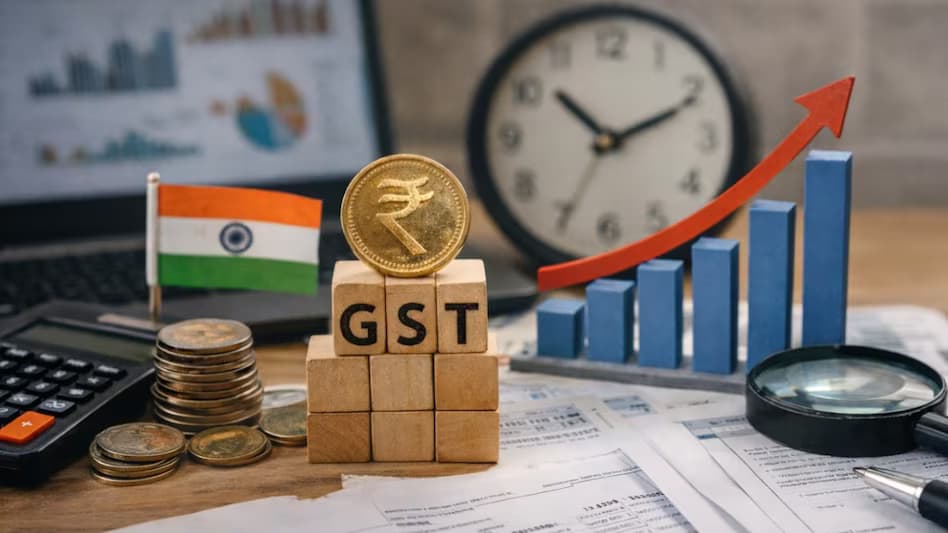
- Goods and Services Tax (GST): Enacted in 2017, GST provides a unified tax framework. The latest reform, referred to as Next-Gen GST, aims to simplify compliance and rationalize tax rates.
Economic Performance and Indicators
- Taxable Supplies Growth: From October 2025 to July 2026, taxable supplies increased by 25.8% year-on-year.
- GST Collections: Gross collections reached ₹12.46 lakh crore during April–September 2026, marking a growth of 11.6% compared to the same period in the previous year. July-September recorded nearly 15% acceleration in collections.
- B2C Sales Growth: Sales to consumers increased by 26.7% post-reform.
Government Schemes and Policies
- Support for Enterprises: Emphasis on facilitating small and medium enterprises (SMEs) access to markets, particularly in Tier-2 and Tier-3 towns, fostering local investment and job creation.
- GST Registrations: Around 1.71 crore registrations reported by August 2026, a 15% increase compared to the previous year.
Administrative Improvements
- Compliance Enhancements: GSTR-3B returns filed timely increased by 12.6% during the April-July 2026 tax periods.
- Input Tax Credit Functionality: Improvement in claims on tax liability which enhances liquidity for SMEs.
- Refund Mechanism: Approx. ₹1.80 lakh crore refunded from April to September; a reliable refund process is deemed essential for business planning.
State Revenue Impacts
- State Goods and Services Tax (SGST): SGST receipts, including Integrated GST (IGST) settlements, increased by approximately 16% in the same period, providing more resources for infrastructure and services.
Future Directions
- Ongoing Reforms: Upcoming proposals to the GST Council include improvements in registration, returns, and the input tax credit process, formulated with state-level consultations to ease compliance costs.
- Commitment to Taxpayer Experience: Continuous focus on administrative performance and taxpayer satisfaction to foster an environment conducive for long-term investments and enterprise growth.
Economic Aspirations
- The overarching goal is to construct a robust economic framework that contributes to a vision of Viksit Bharat, fostering a mature, fair, and efficient tax system that enhances the growth potential of all sectors within India's economy.
Conclusion
The reforms and performance metrics outlined reflect a clear trajectory of growth and empowerment for both businesses and consumers in India, reinforcing the foundations of a developed Bharat as envisioned by the government.
Key Terms & Concepts
| Goods and Services Tax (GST) | National framework for indirect taxation |
| Next-Gen GST | Reform for compliance and rates |
| September 22, 2025 | Effective date for rate changes |
| ₹12.46 lakh crore | Gross GST collections Apr-Sep 2026 |
| 25.8% | Growth in reported taxable supplies |
| 10.4% | Growth in net collections after refunds |
| 1.71 crore | GST registrations across jurisdictions |
| ₹1.80 lakh crore | Refunds during Apr-Sep |
| 16% | Growth in SGST receipts |
| 7 October | Proposals before the GST Council |