iAspirants
Himalaya Glaciers Melt Impact Water Security
Published on:
Share this post
Article Summary
Summary of Key Facts and Data on Himalayan Glaciers and Water Security
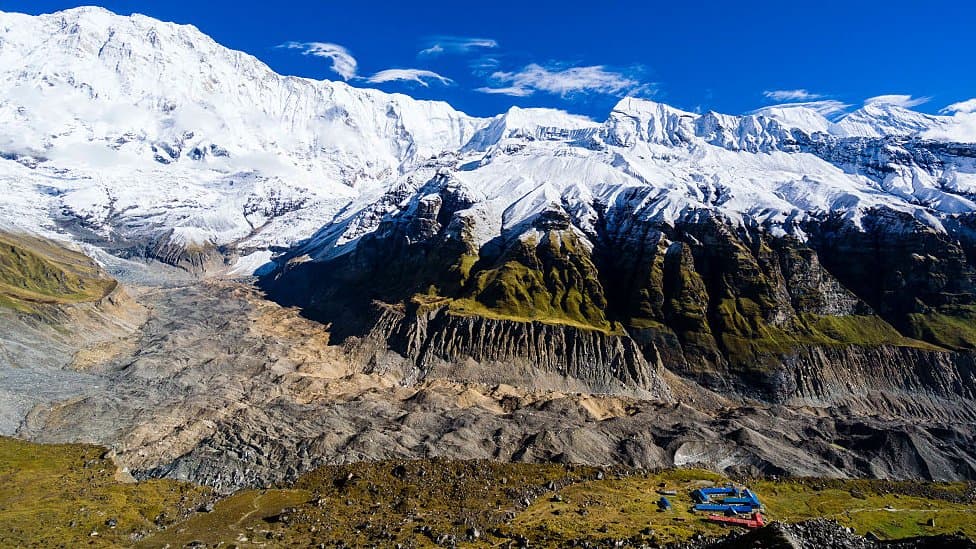
Glacier Melting Trends: The Himalayan glaciers are melting at an accelerated rate compared to a decade ago, indicating an approaching tipping point which threatens regional water security. The phenomenon known as "peak water"—when river flows cease to rise and start to decline—is expected to occur by mid-century.
Impact of Glacier Collapse: A significant glacier collapse occurred in August 2023 along the Nepal-Tibet border, triggering devastating landslides and flash floods. As a result, approximately 1,300 people were confirmed dead, and more than 5,300 were reported missing in the regions of Nepal and Tibet.
Glacial Lakes and Stability Risks: Retreating glaciers have formed unstable glacial lakes, which are at risk of flooding due to their precarious hold of loose rock and ice. This poses a serious threat to the millions of residents in the valleys below.
Economic Value: The Himalayas contribute to over 20% of India's GDP, highlighting their integral role in the national economic infrastructure that supports hundreds of millions of people.
Study Contributors: The alarming findings were released by Systemiq, a sustainability advisory firm, in collaboration with several organizations including the Integrated Mountain Initiative, the International Centre for Integrated Mountain Development, and India's G.B. Pant National Institute of Himalayan Environment.
Monitoring Gaps: There are currently only 21 glaciers being monitored on the ground within the Himalayan region, which consists of an estimated 40,000 glaciers spanning eight countries: Afghanistan, Bangladesh, Bhutan, China, India, Myanmar, Nepal, and Pakistan.
Natural Disaster Correlation: Despite constituting about 18% of India’s total land area, the Himalayan region has been associated with roughly 35% of the country’s natural disasters, reflecting the vulnerability of this ecologically critical area.
Environmental Concern: The findings underscore the urgent need to address climate change impacts and the potential for natural disasters stemming from glacial melting and instability in water resources.
This summary encapsulates critical elements regarding Himalayan glaciers, water security, economic implications, and disaster risks, signifying the importance of proactive measures in response to climate change and environmental management.
Key Terms & Concepts
| Himalayas | Mountain system facing glacier loss |
| Systemiq | Sustainability advisory firm |
| Integrated Mountain Initiative | Collaboration for mountain development |
| International Centre for Integrated Mountain Development | Research on mountain ecosystems |
| G.B. Pant National Institute of Himalayan Environment | Institute for Himalayan studies |
| 20% | Percentage of India's GDP dependency |
| 35% | Percentage of natural disasters from Himalayas |
| 40,000 glaciers | Estimated number across region |
| 1,300 people | Confirmed dead from glacier collapse |
| 5,300 people | Reported missing after disaster |
| 2026-09-15 | Date of publication |
| peak water | Point of river flow decline |