iAspirants
Challenges in Indian Agriculture Sector
Published on:
Source: The Hindu
Share this post
Article Summary
Summary of Key Points on Indian Agriculture and Economic Dependency
Economic Context
- Contribution to GDP: Agriculture constitutes approximately 15-18% of India's GDP.
- Employment: Approximately 46% of the Indian workforce is employed in the agriculture sector, indicating vital dependency despite low GDP contribution.
Structural Challenges
- Landholdings: About 86% of farmers own less than two hectares, leading to limitations in economies of scale and technological adoption.
- Water Dependency:
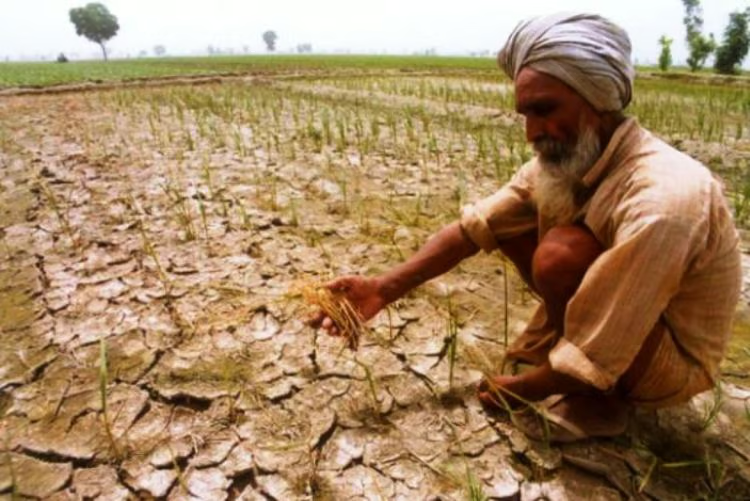
- Around 50% of farmland relies on rain, exposing farmers to drought risks.
- Irrigation practices lead to groundwater depletion, exemplified by the Cauvery water dispute and issues in Punjab.
Climate Change Impact
- Increasingly erratic weather patterns result in crop losses and rising costs (seeds, fertilizers, pesticides).
- Vulnerabilities heightened by climate phenomena like floods and droughts.
Economic Viability of Farming
- Farmers receive a minimal share of the market value for their produce due to weak infrastructural support (storage, processing) and fragmented supply chains.
Recommendations from the National Commission on Farmers (NCF)
- NCF Overview: Chaired by M. S. Swaminathan, the NCF stressed that agricultural problems are primarily about income and livelihood rather than just productivity.
- Essentials for Farmers: Emphasis on access to water, credit, technology, and natural resources to improve farmer livelihoods.
- Ecological Considerations: Advocated for sustainable farming without compromising soil health and water security.
- Market Dynamics: Suggested mechanisms to strengthen farmers' bargaining power and improve market linkages.
Integrated Framework Needs
- Although some NCF recommendations have been put into practice, comprehensive integration remains lacking.
- Call for a shift from MSP-centric models towards strategies focused on overall net farm income and risk management.
Global Market Integration
- The NCF recognized that while Indian agriculture cannot be insulated from global markets, small farmers need protection against market vulnerabilities.
- Necessity for India to implement Free Trade Agreements (FTAs) with adequate supports and safeguards for farmers.
Future Directions
- Proposed re-evaluation and updating of NCF recommendations in light of changes such as climate stress and technology.
- Suggested making the NCF a constitutional body for more robust integration into agricultural policy decision-making.
Additional Context and Philosophical Alignment
- NCF's philosophy aligns with the teachings of former PM Chaudhary Charan Singh, focusing on small farmer viability, rural purchasing power, and a balanced economic model that does not marginalize rural interests.
Conclusion
The NCF's insights provide critical pathways for strengthening the agrarian economy, addressing challenges through integrated economic policies rather than isolated interventions, emphasizing sustainability, and ensuring that small farmers can thrive in both domestic and global markets.
Key Terms & Concepts
| 15-18% of GDP | Agricultural contribution to economy |
| 46% of workforce | Employment in agriculture |
| National Commission on Farmers | Policy recommendations for farmers |
| 86% of farmers | Small landholdings issue |
| Half of all farmed land | Dependency on rainfall |
| Cauvery dispute | Water resource competition |
| Climate change | Intensifying vulnerabilities |
| NCF's comprehensive response | Addressing agricultural distress |
| Direct marketing linkages | Strengthening farmers’ bargaining power |
| Integrated farmer-income architecture | Framework for economic viability |
| Free Trade Agreements | Global market integration |
| MSP-centric thinking | Shift to income-risk management |